
Here's an idea most booking software never acts on: every question a guest asks is a signal that something wasn't clear enough to answer itself. Nobody phones to ask what's already obvious on your website. So the questions people ask on the phone are, quite literally, a list of the things your website, your listings, and your booking flow aren't telling them clearly enough. TripWorks extracts the questions callers ask from every transcript and keeps them — turning a stream of interruptions into a map of the friction in your business.
In this article
Why questions are friction points
If ten callers this week asked "do you have parking?", that isn't just ten phone calls. It's:
- a gap on your website generating ten interruptions for your team,
- plus everyone who wondered and didn't call — some of whom booked with someone clearer instead,
- plus the hesitation that question represents: a small doubt standing between the guest and a booking.
Multiply that across every recurring question and you're looking at real, recoverable cost. The questions guests ask reveal:
- What your website and listings don't answer — the fastest, cheapest wins to cut call volume.
- Where booking hesitation lives — the objections that come up right before people commit, which are exactly what you want to preempt.
- Demand you're missing — repeated asks for a time, a tour, or an option you don't currently offer.
- Where your policies confuse people — cancellations, weather, what's included — the topics that generate the same call over and over.
The mindset shift is simple: don't treat these as questions to answer one caller at a time. Treat the recurring ones as a to-do list. Answer each where guests look first, and the calls for that topic quietly disappear.
From question to fix
The loop looks like this:
- TripWorks surfaces the questions callers keep asking.
- You answer the top ones where guests actually look — the listing, the checkout, your Knowledge Base.
- Your website and AI assistants now field those questions automatically, before anyone picks up the phone.
- Call volume on that topic drops — and the next round of questions shows you what to fix next.
It's a system that makes your business a little clearer every week, using nothing but the calls you were already getting.
Where you see them
- On each call — a Questions section lists exactly what that caller asked, pulled from the transcript, right alongside the Coaching Tips and Business Tips for that same call.
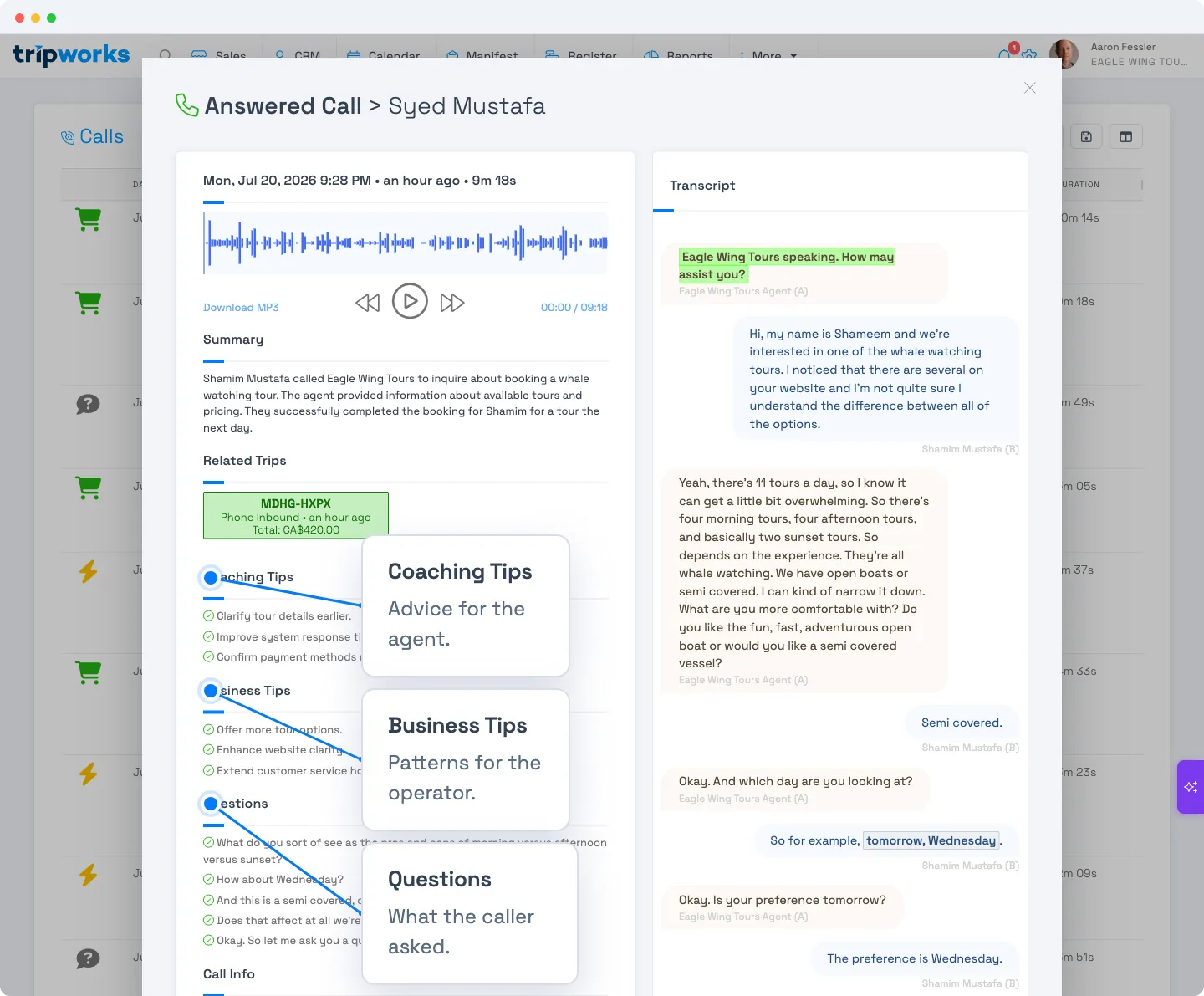
- Across all calls — the Call Intelligence section of your Business Analysis dashboard rolls the questions up so the most common caller questions are obvious, so you can see the patterns at a glance rather than reading calls one by one.
Frequently asked questions
Where do the questions come from?
TripWorks' AI reads each transcript and pulls out the questions the caller asked, then lists them on the call and rolls them up in the Call Intelligence section of your Business Analysis dashboard.
What should I do with them?
Look for the questions that repeat, and answer them where guests look first — your listings, your booking flow, and your Knowledge Base. Fewer surprises means fewer calls.
Why treat questions as "friction" rather than just answering them?
Because a repeated question is a repeated gap. Answering one caller helps one caller; fixing the gap on your website helps everyone who had the same doubt — including the ones who never called and booked elsewhere.
Related
- Build your Knowledge Base
- Sentiment & the moments that matter
- Understanding your Business Analysis dashboard
Built for attractions, tours & activities
Every question is a chance to stop the next call
See how attractions, tours, and activities turn caller questions into fewer calls on TripWorks. Book a demo and make the switch.