
Every call has a feel to it — moments where the caller was happy, and moments where they weren't. TripWorks reads that automatically and highlights the positive and negative moments right in the transcript, so you can see the emotional shape of a call without reading every word.
In this article
How highlighting works
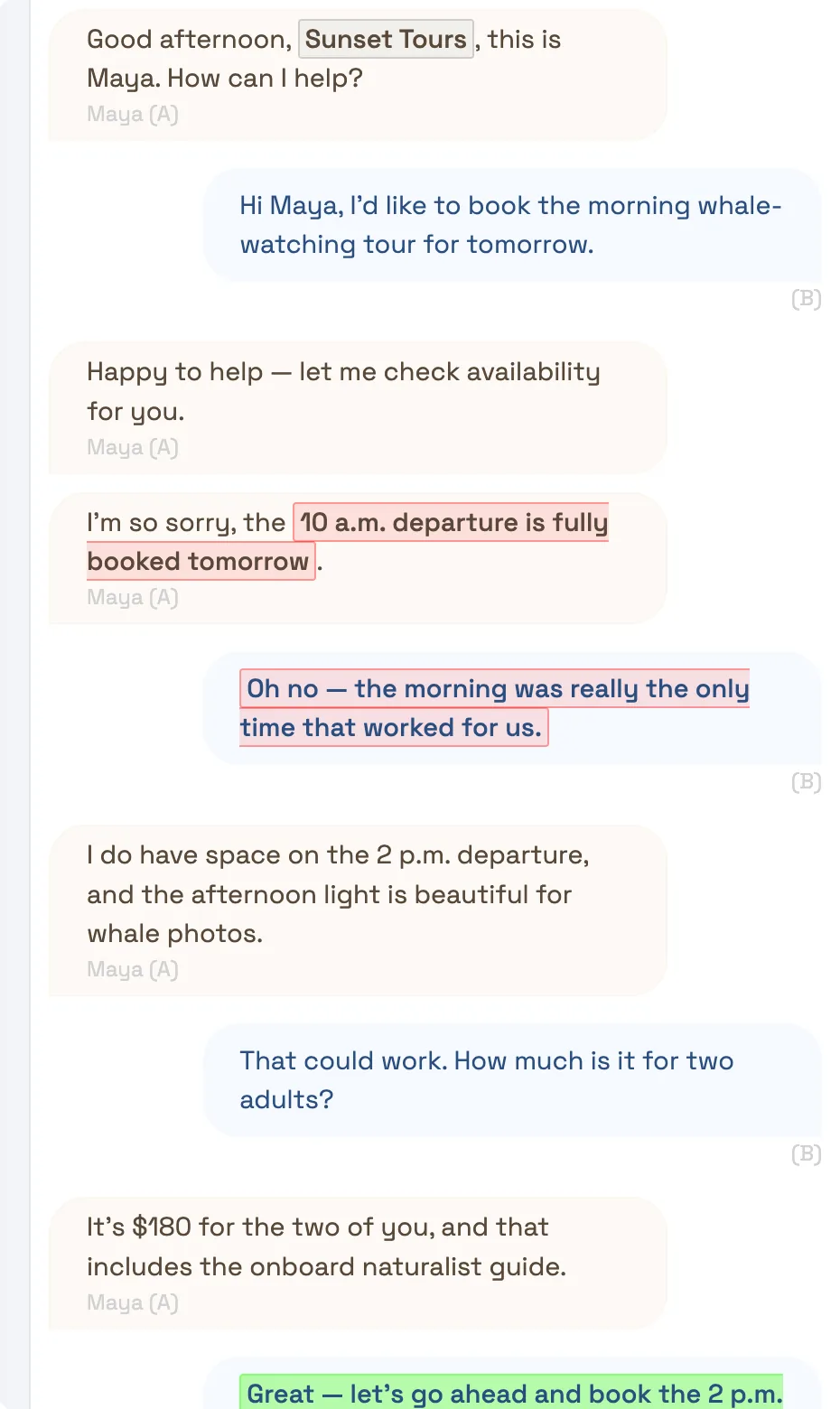
As TripWorks analyzes a call, it doesn't just judge the call as a whole. It pulls out the meaningful moments (names, places, dates, prices, and more) and marks each one positive, negative, or neutral. Those tagged moments are highlighted right in the transcript:
- Green marks a positive moment — enthusiasm, a thank-you, and especially anything about money, a credit card, or paying. That's hardcoded as a strong positive signal, since a caller reaching for their card is about the best signal there is.
- Red marks a negative moment — frustration, disappointment, a complaint, a sold-out "oh no."
- Neutral is everything in between: the ordinary back-and-forth of a normal conversation.
Because it's inline, a quick glance at a transcript tells you the emotional arc of the call — where it started well, where it turned, whether it recovered. You don't have to read every word to know how it felt.
Paired with the CSAT score, you get both halves of the picture: the score is the overall read, and the highlights are the exact lines that drove it. When a call scores low, you can see precisely where it went wrong — not just that it did.
Why the "moments" matter more than an average
A single number can hide a lot. A call can score "fine" overall while containing one moment where the guest was genuinely upset — the moment that decides whether they come back or leave a one-star review. By surfacing the moments themselves, TripWorks lets you act on the part that actually matters instead of an average that smooths it over.
What to do with it
- Triage fast. Negative moments jump out of the list and the transcript, so you can call an unhappy guest back before they vent in a public review.
- Find your wins. Calls full of green are ready-made examples for training and for recognizing the people who handle guests brilliantly.
- Spot patterns. When the same negative moment keeps recurring — the same policy, the same wait time, the same confusing step — that's not a series of bad calls, it's one problem to fix. Sentiment turns scattered frustration into a clear, repeatable signal.
- Protect your reputation. The unhappy caller you catch today is the bad review you don't get next week.
Frequently asked questions
How is sentiment decided?
TripWorks' AI reads the transcript and marks the meaningful moments positive, negative, or neutral based on what was said. Anything about money, a credit card, or paying is hardcoded to count as positive.
Where do I see it?
Right in the call's transcript — the tagged moments are highlighted by sentiment (green positive, red negative). Open any call from the Calls list to see it.
What counts as a positive moment?
Enthusiasm, gratitude, and anything about money, a credit card, or paying. That last category is hardcoded as a strong positive signal, since a caller ready to pay is exactly what you want to see.
How is this different from the CSAT score?
CSAT is one score for the whole call. Sentiment highlighting marks the individual moments inside it — so you can see the specific lines that made the call good or bad, not just the average.
Related
Built for attractions, tours & activities
See how a call felt, not just what was said
See how attractions, tours, and activities read call sentiment at a glance on TripWorks. Book a demo and make the switch.