
Booking widgets let you sell directly on your own website, with no commissions and no redirects to a third party. You build them in a visual builder with a live preview, then drop a snippet on your site. They all live in Booking Widgets.
In this article
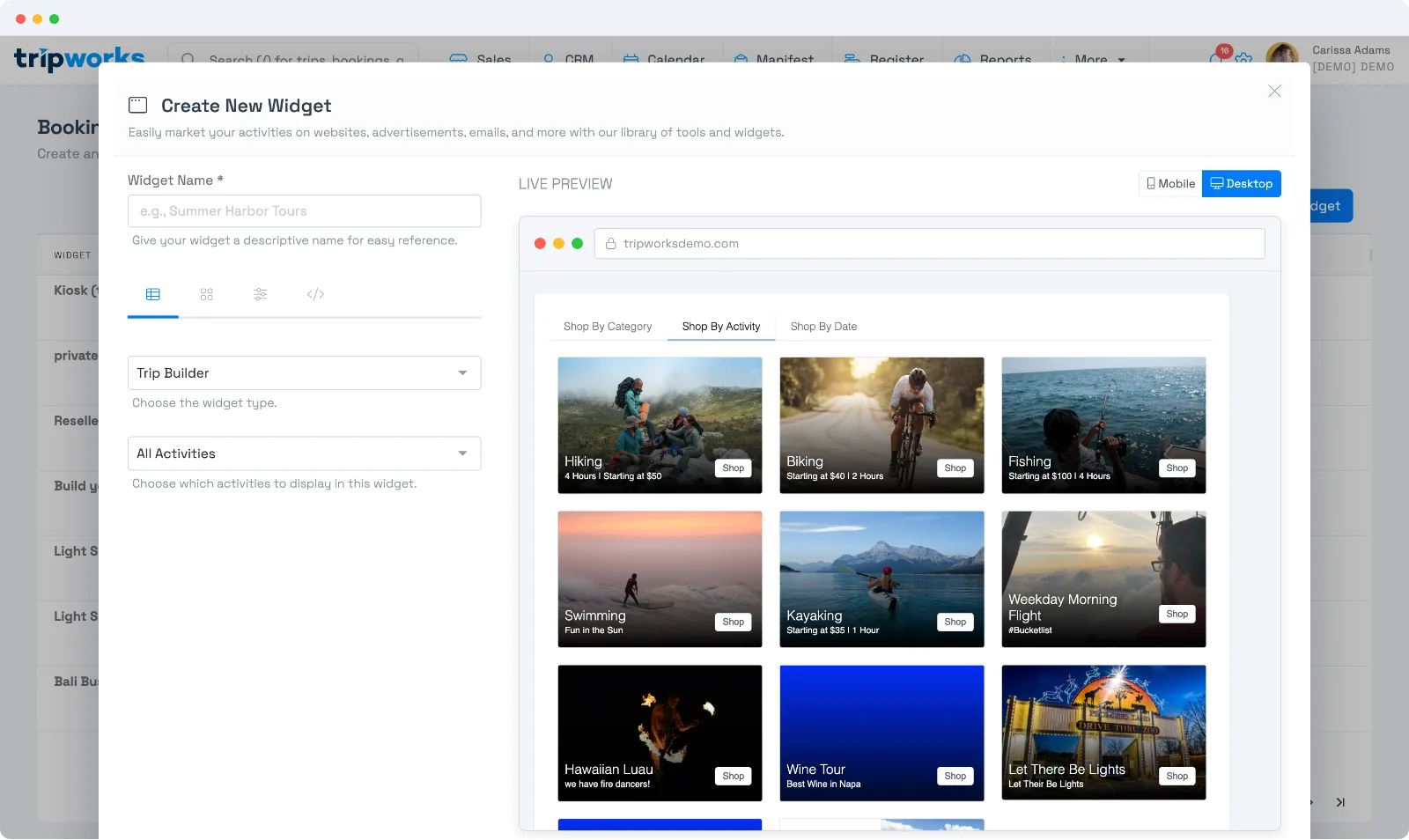
Choose a widget type
- Trip Builder — your full booking flow: a catalog of activities that guests browse, select, and check out from. The everyday choice for a website "Book Now" page.
- Calendar — an availability calendar that opens into booking, great when guests shop by date.
- Kiosk — an on-site, self-service widget for a tablet at your location. (Available on request — ask your account manager to switch it on.)
Decide what it shows
Pick which of your activities appear:
- All activities — your whole catalog.
- Individual activities — hand-pick specific ones (use one activity for a single-activity "book this tour" widget).
- Categories — everything in the categories you choose, so new activities in those categories appear automatically.
Activities display in one order across every widget: the order set for your whole catalog in Activity Settings. See the FAQ below.
Shape the experience
Fine-tune how the widget looks and behaves:
- Default view — Catalog, Calendar, Agenda, Categories, or Gift Cards.
- Display mode & layout — Full Details or a Compact view; catalog item layout.
- Prices — show dynamic pricing and time-slot prices, or keep it clean.
- Default to "Flex Booking": open the widget on Choose Date Later instead of the calendar, so guests book now and pick their date later. See Default a widget to Choose Date Later below.
- Default language — the language the widget loads in (see multiple languages).
The live preview (mobile and desktop) updates as you change these.
Default a widget to Choose Date Later
Guests booking an activity with vouchers turned on see a Calendar | Choose Date Later toggle. Normally the widget opens on Calendar. To open it on Choose Date Later instead:
- Open the widget in the builder.
- Check Default to "Flex Booking".
- Save the widget.
How this setting works:
- It belongs to the widget, not the activity. Every activity in that widget opens on Choose Date Later. Each activity's Vouchers tab only controls whether the activity offers Choose Date Later at all.
- Guests can still switch. The toggle stays visible, so a guest can tap Calendar and book a date right away.
- Kiosk widgets don't offer it. The checkbox is hidden for the Kiosk type, since walk-up guests book a time on the spot.
- Turn vouchers on for the activities in it. When a widget defaults to Choose Date Later, the toggle shows for every activity in it. Turn on vouchers for each of those activities so unscheduled bookings are treated as vouchers.
Different defaults for different activities. There's no per-activity default. To have some activities open on Choose Date Later and others on Calendar, build two widgets: one with Default to "Flex Booking" checked that shows only the open-dated activities, and one without it for the rest. You can also add defaultBookingMode=chooseTimeLater to a single link. See Deep-link your widget with URL parameters.
Voucher-only selling. There's no setting that removes the calendar and offers only Choose Date Later. The closest setup is a widget that shows only your voucher activities with Default to "Flex Booking" checked. Guests land on Choose Date Later, though the Calendar option remains available to them.
Manage your widgets
The Booking Widgets list shows every widget with its type, and how it's performing — embeds, clicks, and interactions. From each row you can edit, install (get the embed code — see Embed your booking widget), or clone it.
What the Usage numbers mean
The Usage column shows two numbers, such as 154 / 20:
- The first number is how many times the widget has loaded on a live page since you created it. Each time a visitor opens a page with the widget on it, that's one more. Opening the widget's preview in the builder doesn't count.
- The second number is how many interactions visitors have had with it, such as choosing an activity, picking a date or time, changing the number of guests, adding to cart, answering a booking question, or completing a purchase. Each action counts once, so one visitor who books can add several.
So 154 / 20 means the widget has loaded 154 times and visitors have taken 20 actions in it. A high first number with a low second one usually means people see the widget but don't start a booking. Both numbers are running totals, not for a date range. Last Seen shows when the widget last loaded on a live page. To see where your bookings came from, use the Marketing reports and each trip's More tab.
Widgets for a reseller
To give a reseller their own widget or link, open the reseller from Resellers and select its Widgets tab. You build the same widget types there, and bookings made through them are attributed to that reseller automatically.
Group and track bookings by website
If you run more than one website, brand, or domain under the same account, for example a main site plus a few separately-branded partner sites, the way to keep their traffic separate isn't a distinct grouping feature. It's one widget per site. Build a widget for each site (see Choose a widget type above) and install it only there (see Embed your booking widget). Because every widget already tracks and reports on its own, that alone gives you traffic broken out by site, in two places:
- Aggregate, per site. The Booking Widgets list reports embeds, clicks, and interactions separately for each widget, so as long as each site has its own widget, you can compare site-to-site performance at a glance.
- Per booking, per site. Every trip records exactly which widget the guest used. Open the trip and check the More tab: you'll see a Widget field with that widget's name (select it to jump back to the widget) and its widget ID.
Frequently asked questions
Why isn't my activity showing up on my widget?
Two things to check: the activity must be published (bookable), and it must be included in that widget's selection — either the widget shows all activities, or the activity is in one of the widget's chosen categories or its individual-activities list.
Can I change the order activities appear in on a widget?
Yes. Open Activity Settings, select Reorder, and drag activities into the order you want.
This order is set once for your whole catalog, not per widget. Every widget that includes an activity shows it in that same position relative to your other activities, so there's no separate order to set for just one widget. A new activity you create is added to the end of this order automatically; drag it into place once it's ready to feature.
Can I have more than one widget?
Yes — create as many as you need. A common setup is one full-catalog widget for your main booking page plus single-activity widgets for individual tour pages.
Do I need a developer?
No. You build the widget here and paste a small snippet onto your site — see Embed your booking widget. Most site builders let you paste it into an embed/HTML block.
We run bookings through more than one website — can we tell which site a booking came from?
Yes. Create a separate widget for each site (or brand) and install it there (see Embed your booking widget). Every booking records which widget the guest used, so you can always trace it back: open the trip and check the More tab for the Widget field.
Does TripWorks have "business groups" for organizing bookings from different sites or brands?
Not as a separate feature to configure. The practical equivalent is giving each site or brand its own widget: since every widget already reports its own embeds, clicks, and interactions, and every booking records which widget it came through, one widget per site gets you the same grouping without any extra setup.
What do the two numbers in the Usage column mean (like 154/20)?
The first number is how many times the widget has loaded on a live page since it was created. The second is how many interactions visitors have had with it, such as picking an activity, a date or time, or a guest count, adding to cart, or completing a purchase. Each action counts separately, so one booking can add several. Previewing the widget in the builder doesn't count. Both are running totals, not for a date range.
How do I set a widget to default to choose date later?
Open the widget from Booking Widgets, check Default to "Flex Booking", and save. The widget then opens on Choose Date Later instead of the calendar. Guests can still switch to Calendar to book a date now.
Is the choose date later default set on the widget or on the activity?
On the widget. Default to "Flex Booking" applies to every activity in that widget. The activity's Vouchers tab decides whether Choose Date Later is offered for that activity, but not which option is selected first.
Can I default to choose date later for some activities and not others?
Not within one widget. Create a separate widget that includes only the activities you want to open on Choose Date Later, and check Default to "Flex Booking" on that widget. Leave it unchecked on your other widget. For a single link, you can add defaultBookingMode=chooseTimeLater to the widget URL.
Can a widget show only vouchers and not a date and time?
Not entirely. No setting hides the calendar. The closest option is a widget that shows only your voucher activities with Default to "Flex Booking" checked, so guests start on Choose Date Later. They can still switch to Calendar if they want to book a date.
Related
- Embed your booking widget
- Deep-link your widget with URL parameters
- Marketing attribution & UTM tracking
Built for attractions, tours & activities
Sell direct, straight from your own website
See how attractions, tours, and activities take commission-free bookings with TripWorks widgets. Book a demo and make the switch.