
A resource is a physical thing you only have so many of that an activity needs in order to run — a kayak, a bike, a paddleboard, a seat on a bus. You add your resources here so TripWorks can keep availability in line with what you actually own: when every kayak is booked, the kayak tour stops selling, even across different activities that share the same fleet.
In this article
Every resource belongs to one resource group (Kayaks, Bikes, Boats). Groups are how activities ask for equipment — an activity says "I need 1 from Kayaks per guest," and TripWorks does the counting.
How resources cap your availability
This is the part worth understanding — it's why resources exist, and it isn't obvious from the setup screen. Resources are a shared capacity pool, not just a checklist:
- Each resource has Max Uses — how many can be in use at the same time. A single kayak is
1; a 40-seat bus is one resource with Max Uses40. - Resources are pooled by group. An activity declares how many of a group each ticket needs (that's set on the activity, not here — see resource requirements per ticket type).
- As bookings come in, TripWorks draws down the group's pool for that time and closes availability automatically once it's committed — so you can't sell more kayak seats than you have kayaks. Because the pool is shared, two activities that both use the Kayaks group draw from the same kayaks, and neither can oversell them.
- The resources committed to a booking show up on the Manifest — with the name, icon, and color you set — so staff know exactly what goes out the door.
The upshot: model your real inventory here, tell each activity what it needs, and availability takes care of itself.
Add a resource
Go to Setup Run your day Resources and select New Resource.
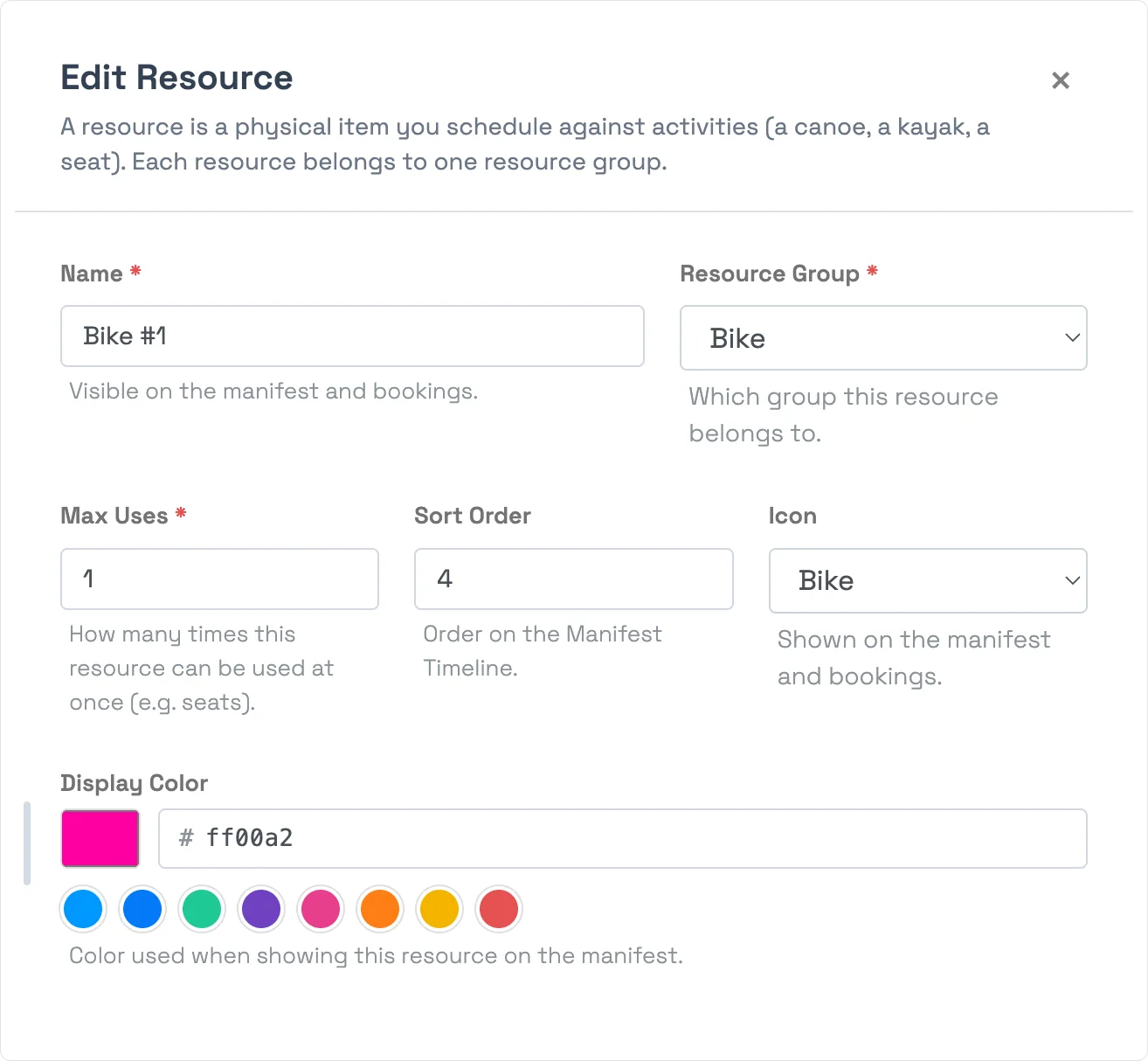
- Name — what staff see on the manifest and bookings, like "Canoe #12."
- Resource Group (required) — the group this belongs to (create groups first, or from the same screen — see below).
-
Max Uses — how many can be in use at once. Use
1for a single item tracked on its own; use the seat count for something interchangeable like a bus or a boat. - Sort Order — where it sits on the Manifest Timeline.
- Icon and Display Color — how it's shown on the manifest so it's easy to spot.
Two ways to model a fleet: add each unit as its own resource (Bike #1 … Bike #10) when you track them individually, or add one resource with Max Uses set to the total (one "Bus" with Max Uses 40) when the units are interchangeable seats. Both cap availability the same way.
Organize with resource groups
Select Manage Resource Groups on the toolbar to add, rename, or remove groups. A group is just a name (Kayaks, Bikes) — you set which group a resource belongs to on the resource itself, not here.
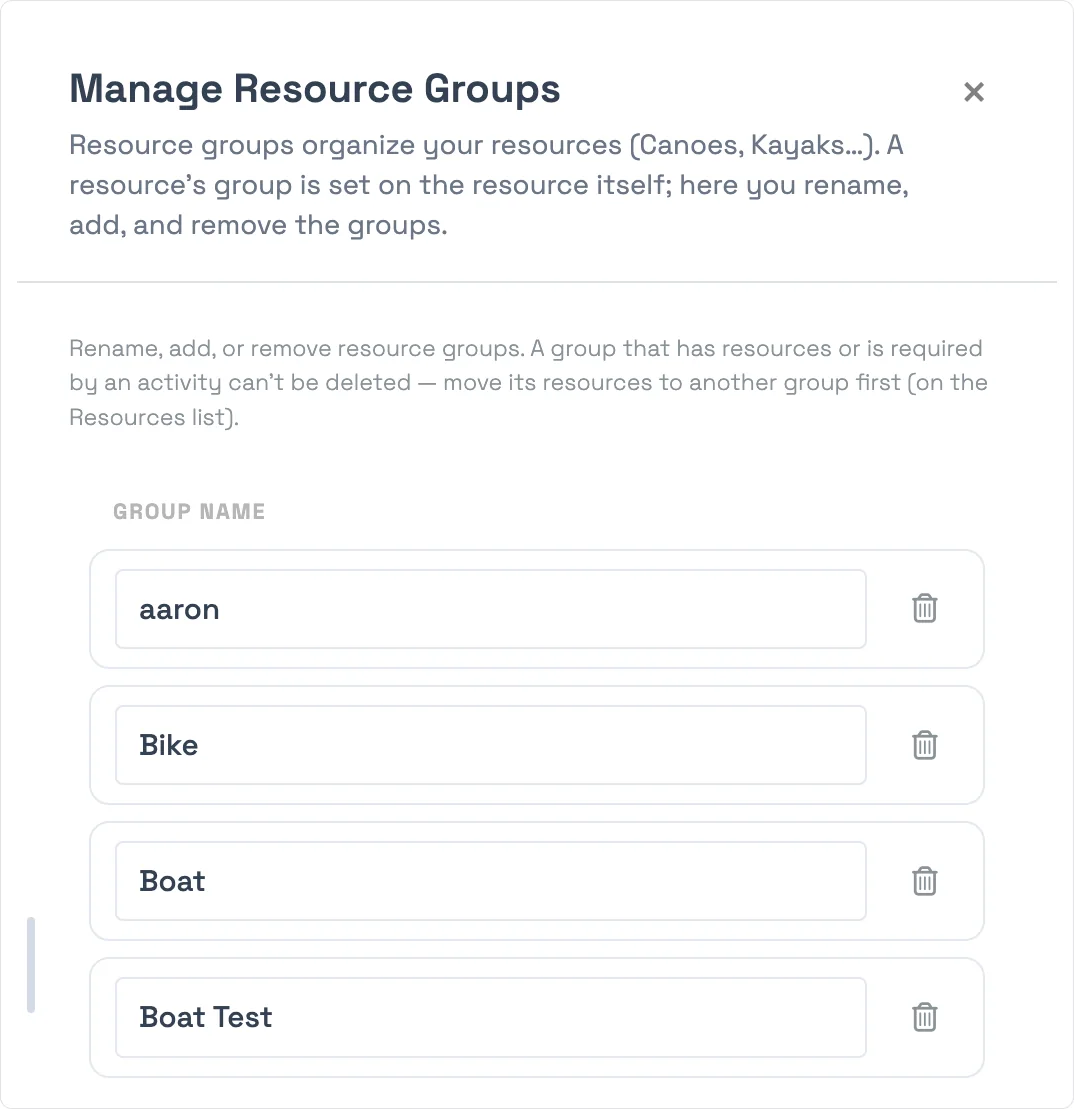
You can't delete a group that still has resources, or that an activity requires — TripWorks will tell you. Move its resources to another group first, then remove it.
Resource settings
The Settings (gear) button holds account-level labels for how resources are described across your dashboard — handy if you think of your resources in your own terms. It doesn't change how they work, only what they're called.
Deleting a resource
A resource that's been used on a booking can't be deleted — it's part of that booking's record, and removing it would break history. TripWorks blocks the delete and says so. Resources you added by mistake or never used can be deleted freely.
Frequently asked questions
What's the difference between a resource and a resource group?
A resource group is the category (Kayaks, Bikes, Boats); a resource is an actual item in it (Kayak #3). Activities request a group — "1 from Kayaks per guest" — and TripWorks draws from the resources in that group.
How do resources limit availability?
They form a shared pool per group. Each resource's Max Uses sets how many can run at once; when an activity's bookings commit the group's pool for a timeslot, that timeslot stops selling — automatically, and across every activity that uses the same group. You can't sell more than you own.
I have a 40-seat bus — is that one resource or forty?
One resource with Max Uses set to 40. Only track seats as separate resources if you assign specific seats individually — otherwise one resource with the right Max Uses is simpler and caps capacity the same way.
How do I make an activity actually use a resource?
Set a resource requirement on the activity — how many of a group each ticket type reserves. See resource requirements per ticket type. Adding a resource here makes it available to be required; the activity side is where you connect it.
Why can't I delete a resource or a group?
A resource that's on any booking can't be deleted (it's part of that history). A group can't be deleted while it still has resources or is required by an activity — move its resources to another group first.
Related
- Resource requirements: set resources reserved per ticket type
- Activity capacity by resources
- Locations
Built for attractions, tours & activities
Never oversell your equipment again
See how attractions, tours, and activities track boats, bikes, and seats so availability matches what they actually own — in one place on TripWorks. Book a demo and make the switch.